
The $3.2 Million Lie: What That Influencer Isn't Telling You About His Lamborghini
The people screaming about their wealth are usually the ones making money by screaming about their wealth.


Six months ago, I had coffee with a “e-com influencer” who posts about his seven-figure lifestyle in Austin, TX.
Private jets. Luxury watches. Screenshots of bank accounts. The whole performance.
His Instagram said he made $3.2 million last year from “e-commerce and coaching.”
Over coffee, the truth came out.
He made $180,000 last year. Total. Still a lot, but nowhere near $3.2 million.
The Lamborghini? Rented for photo shoots. $800 for four hours.
The private jet? Never actually flew on it. Paid $300 to take photos on a parked plane at a local airport.
The “seven-figure business”? He counted gross revenue, not profit. And most of that revenue came from selling a $1,997 course teaching other people how to “build a seven-figure business.”
His actual business—the e-commerce thing he claimed made him rich? It generated $47,000 in revenue and lost $8,000 after expenses.
He wasn’t making millions from business.
He was making $180,000 selling the dream of making millions from business.
Here’s what nobody tells you about the influencer economy: The product is the dream, not the result.
And you’re the customer.
The Influencer Playbook (Decoded)
“It is difficult to get a man to understand something when his salary depends on his not understanding it.” — Upton Sinclair
Here’s the formula they all use:
Step 1: Rent the lifestyle for content
Lamborghini rental: $500-$1,500/day
Private jet photoshoot: $200-$500
Luxury Airbnb for “my house” content: $300-$800/night
Designer clothes for one video: Borrowed or rented
Total monthly cost for “millionaire lifestyle” content: $3,000-$5,000
Step 2: Show revenue, never profit
“I made $100K this month!”
Translation: Gross revenue before refunds, chargebacks, ad spend, software costs, team salaries, and taxes.
Actual take-home after expenses? Maybe $15K. Maybe less. Sometimes negative.
But “$100K month” sounds better than “I netted $8,000 after everything.”
Step 3: Sell the system that “got them there”
Here’s the dirty secret: Most influencers make more money teaching people how to get rich than they ever made from the business they claim made them rich.
The real estate guru who made $50K flipping houses? He made $2M selling courses on how to flip houses.
The e-commerce expert who built a “seven-figure brand”? He makes more from his $3,000 coaching program than from his actual store.
The “retired at 30” entrepreneur? Still working 60 hours a week creating content and selling courses about retirement.
Step 4: Use fake urgency and FOMO
“Only 3 spots left!”
“This closes at midnight!”
“I’ll never offer this price again!”
All lies. The course reopens next month. There are unlimited spots. The price never actually changes.
They manufacture scarcity to trigger your fear of missing out.
Step 5: Show the highlights, hide the truth
They’ll show you:
The $50K day
The Stripe screenshot
The luxury vacation
The “passive income” myth
They won’t show you:
The $30K refund rate
The 80-hour work weeks
The $200K in debt funding the lifestyle
The mental health crisis from living a lie
The marriage falling apart because everything is content
The Math They Don’t Want You to See
“Comparison is the thief of joy.” — Theodore Roosevelt
Let’s do some basic math on a “successful” course-selling influencer:
Revenue:
Course price: $2,000
Sales per month: 50
Gross monthly revenue: $100,000
Annual gross: $1,200,000
Sounds incredible, right? “Seven-figure business owner!”
Reality (Actual Expenses):
Ad spend (Facebook/Instagram/YouTube): $40,000/month
Software and tools: $2,000/month
Video editor and team: $8,000/month
Affiliate commissions: $15,000/month
Refunds (20% average): $20,000/month
Chargebacks and payment processing: $3,000/month
Business taxes and accounting: $5,000/month
Total monthly expenses: $93,000
Actual monthly profit: $7,000
Annual take-home: $84,000
That’s still good money. But it’s not “seven figures.”
And it requires maintaining an audience, constant content creation, managing a team, dealing with angry customers, and living a life where everything you do is performance.
Oh, and if the algorithm changes or ad costs increase? That $84K can drop to $30K overnight.
Is that really the dream they’re selling?
What “Retired at 30” Actually Means
“Retirement is not the end of the road. It is the beginning of the open highway.” — Unknown
Here’s my favorite influencer lie: “I retired at 30.”
No, you didn’t.
You just changed jobs.
“Retirement” means:
Creating content 6 hours a day
Responding to DMs to maintain engagement
Running paid ads to keep the funnel alive
Updating courses when students complain
Doing sales calls with potential coaching clients
Managing contractors and team members
Dealing with customer support issues
Constantly creating new offers because the last one saturated
That’s not retirement. That’s a full-time job with no boss and inconsistent income.
Actual retirement means you stop working and your assets generate enough income to sustain your lifestyle.
What these influencers built isn’t passive income. It’s a personal brand that requires their constant presence to survive.
The moment they stop posting, the income stops.
That’s not freedom. That’s a different kind of prison—one where your entire life becomes content and your value is measured in engagement metrics.
The Deceptive Tricks You Need to Recognize
“A lie can travel halfway around the world while the truth is putting on its shoes.” — Mark Twain
Trick 1: The “Screenshot Proof”
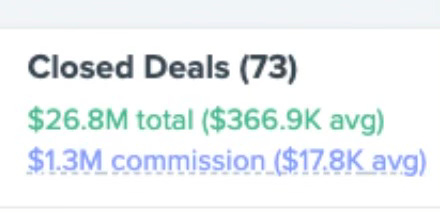
Yes, this is legit. I assisted my client in generating a substantial amount of business in real estate. But here's the full story:

These 73 deals represent the collective efforts of his entire team throughout the year (that's their commission... not mine). Additionally, the deals were made in Atlanta, where property prices are inherently higher. Lastly, my contributions were limited to building his team’s website and enhancing their social media presence.

Without that added context, it seems as though I single-handedly generated $27M for my client in revenue and received a $1.5M commission.
Bank screenshots can be faked in 60 seconds with inspect element in Chrome.
Stripe dashboards? Same thing.
PayPal screenshots? Easily manipulated.
Even if they’re real, they show revenue, not profit. And they never show the full picture—just the one big day that makes them look successful.
Trick 2: The “Lifestyle by Association”

This is my co-founders and I pitching the President of Microsoft, Brad Smith, in one of our investors' companies. While it looks great, this was not the norm by any means.They post photos with actually successful people and let you assume they’re at the same level.
“Just had dinner with [famous entrepreneur]” = They paid $5,000 to attend a mastermind event where they got a photo.
“Closed a deal with [big company]” = They sold them a $500 consulting call.
Trick 3: The “Fake It Till You Make It” Culture

The above image looks like I made it, huh? I posted it on Facebook because I wanted all of my former classmates and teachers, family, and friends to think I was just killing. I even had people wanting to pay me to teach them how to pitch (I only had two slides and barely got through those lol)

Had I posted it with the intent to simply share our journey, no problem. But I didn’t.
They’ll tell you to “act as if” and “step into the identity of a millionaire.”
Translation: Spend money you don’t have to look successful so you can convince people to give you money.
This is how people go into six-figure debt trying to maintain an image that attracts customers.
Trick 4: The Survivorship Bias Story
I don’t have any screenshots of this… but I have used it before lol“I dropped out of college and built a seven-figure business!”
What they don’t mention: 10,000 other people did the same thing and failed miserably.
They’re the 1% success story. But they pitch it like it’s a guaranteed formula.
It’s not. They got lucky, worked insanely hard, or more often—they’re lying about the numbers.
Trick 5: The “Invest in Yourself” Manipulation
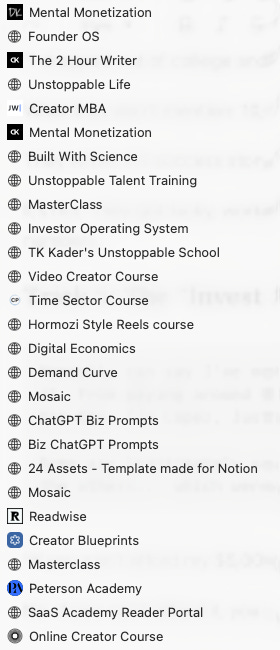
Honestly can say I've never used this angle, but I have become victim of it. The screenshot is a portion of the courses I've purchased.

From paying around $20k over the last 8-ish years on courses from Dan Koe, Tia Lopez, Justin Welsh, Dan Lok, Grant Cardone, and more.

Some are legitimately valuable (Dan's, Justin's, and Grant's) but not the others... which were the more expensive ones.
“If you can’t afford my $5,000 course, you’re not serious about success.”
No. If you can’t afford it, you probably shouldn’t buy it.
This is manipulation designed to make you feel like financial irresponsibility is ambition.
Real investment in yourself looks like: Books. Free content. Learning by doing. Building skills. Not going into debt for a course that promises transformation.
What They’re Really Selling (And Why It’s Dangerous)
“The mass of men lead lives of quiet desperation.” — Henry David Thoreau
The influencer economy isn’t selling business strategies.
It’s selling an escape from the anxiety of normal life.
You’re working a job you tolerate. You’re stressed about money. You see someone on Instagram who claims they escaped—and now they’re on a beach making money while they sleep.
That’s the drug. The promise of escape.
And it’s almost always a lie.
What they’re actually doing:
Working more hours than you
Dealing with inconsistent income
Constantly worried about algorithm changes
Living a performance for engagement
Building a business that completely depends on them
They traded one form of stress for another. But at least their stress looks good on Instagram.
The Lifestyle Business Alternative Nobody Talks About
“Wealth is the ability to fully experience life.” — Henry David Thoreau
Here’s what actually works. What actually builds real wealth. What actually gives you a good, noble life.
Build a lifestyle business.
Not a unicorn startup. Not a seven-figure personal brand. Not a “retire at 30” scheme.
A simple, profitable business that:
Solves a real problem for real people
Generates consistent profit (not just revenue)
Doesn’t require you to become an influencer
Allows you to live well without performing online
Builds actual wealth through reinvestment and savings
What this actually looks like:
You run a web design/hairstylist/AI automation business that makes $180K/year in profit. Not revenue. Actual money you keep after expenses.
You work 30-40 hours a week. You have 5-10 great clients. You charge premium rates because you’re excellent at what you do… not because some “guru” says that’s what they charge.
You’re not famous. You’re not on Forbes. You’re not speaking at conferences.
But you’re:
Saving $60K per year
Investing in index funds
Building real wealth slowly
Living in a nice home you can actually afford
Spending time with family
Sleeping well at night
Not worried about engagement rates or algorithm changes
In 20 years, you’ll have $1.5M+ in investments. Real money. Not screenshots. Not rented Lamborghinis. Actual wealth.
That’s not sexy. It won’t get likes on Instagram.
But it’s real. It’s sustainable. It’s honest.
The Quiet Millionaires Nobody Posts About
“Do not spoil what you have by desiring what you have not; remember that what you now have was once among the things you only hoped for.” — Epicurus
You want to know who the actual wealthy people are?
They’re not on Instagram flexing.
They’re:
The boring accountant who built a firm with 15 employees
The consultant who charges $500/hour and works 20 hours a week
The software developer who built a niche SaaS product generating $40K/month in profit
The local business owner with three locations and zero social media presence
The couple who lived below their means and invested consistently for 25 years
These people have real wealth. Millions in assets. Financial security. Time freedom.
And you’ve never heard of them. Because they’re not selling you anything.
They’re too busy living the life the influencers are pretending to have.
The Questions You Should Ask Instead
“The unexamined life is not worth living.” — Socrates
When you see someone flexing online, ask yourself:
Are they selling the result or the process?
If their business is teaching you how to do what they did, they’re not successful at the thing—they’re successful at selling the dream. I personally prefer to just document what works for ME. I’m not saying it will work for you, but at least you can try… but there are no guarantees.Do they show profit or just revenue?
Revenue is vanity. Profit is reality. Anyone can generate revenue by spending more on ads. Show me the profit margins.Would they still do this if they couldn’t post about it?
If the answer is no, they’re not building a business—they’re building an audience. Those are two very different things.What are they sacrificing that they’re not showing?
Every choice has a cost. What’s the cost of the lifestyle they’re portraying?Is this the life I actually want?
Or am I just attracted to the performance of success? I thought I really wanted a Mercedes. Now that I have one, I would be 110% content with a Tesla… which is what I was saving for in the first place. Yet, I saw other founders on IG driving Mercedes and assumed I needed to “fit in”.
The Better Path Forward
You don’t need to retire at 30.
You don’t need a Lamborghini.
You don’t need to be Instagram famous.
You need:
A profitable skill people will pay for
Clients who value your work
Consistent systems that generate revenue
Reasonable expenses that don’t require performance
Time to build real wealth through saving and investing
A life you don’t need to escape from
That’s the real dream.
Check This Out 👇🏽
If you want that dream, then you'd want to check out my $2,000 course on how to build a business that... I'm just playing lol 😂
Not the private jet photo shoots.
Not the fake bank screenshots.
Not the course launch that makes $100K but costs $85K to deliver.
Build something real. Build something sustainable. Build something that serves others while building wealth for yourself.
Live below your means. Invest the difference. Compound for decades.
That’s how you actually get wealthy.
It’s boring. It’s slow. It won’t get you likes on social media.
But in 20 years, you’ll have millions in the bank while the influencers are still renting Lamborghinis for content.
The choice is yours.
Stop buying the dream from people selling courses.
Start building the reality through consistent, honest work.
Your future self will thank you.
“There is only one success—to be able to spend your life in your own way.” Christopher Morley.
Loved this post!